

Description
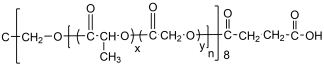
8-Arm PLGA-N₃ is a highly branched biodegradable polyester designed for advanced drug delivery and biomedical applications. The polymer consists of eight PLGA chains attached to a central multifunctional core, creating a star-shaped architecture with multiple terminal azide groups.
The azide functionalities readily participate in copper-catalyzed azide-alkyne cycloaddition (CuAAC) and strain-promoted azide-alkyne cycloaddition (SPAAC) reactions, enabling efficient conjugation of peptides, proteins, antibodies, fluorophores, nucleic acids, targeting ligands, and other biomolecules. Compared with conventional linear PLGA derivatives, the eight-arm architecture offers substantially higher reactive group density and increased versatility for the preparation of multifunctional nanoparticles, targeted delivery systems, and crosslinked biomaterials.
Upon hydrolysis, the polymer degrades into lactic acid and glycolic acid, making it suitable for biodegradable pharmaceutical formulations, regenerative medicine, and biomaterials development.
Applications
- Drug delivery systems
- Polymeric nanoparticles
- Polymeric micelles
- Click chemistry conjugation
- Targeted drug delivery
- Surface modification
- Hydrogel formation
- Tissue engineering
- Biomaterials engineering
- Nanomedicine research
Features and Benefits
- Star-shaped eight-arm PLGA architecture
- Multiple terminal azide groups
- Higher functional group density than linear PLGA
- Compatible with CuAAC and SPAAC click chemistry
- Biodegradable and biocompatible
- Enhanced drug loading capability
- Suitable for nanoparticle and hydrogel fabrication