
Description
General Description
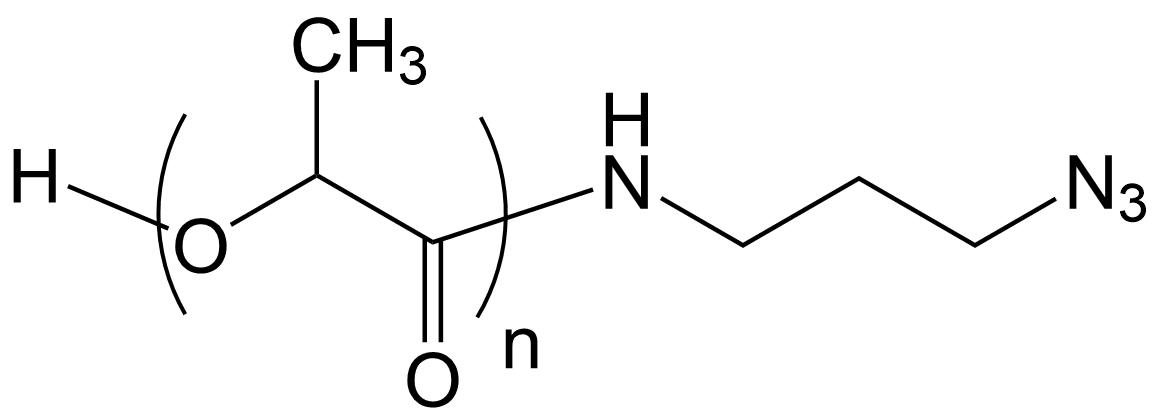
PDLLA-Azide (PDLLA-N3) is a functional aliphatic polyester derived from D,L-lactide. Unlike crystalline PLLA, PDLLA is amorphous, resulting in more uniform degradation behavior and broader applicability in pharmaceutical and biomedical applications.
The terminal azide group readily participates in copper-catalyzed azide-alkyne cycloaddition (CuAAC) and strain-promoted azide-alkyne cycloaddition (SPAAC) reactions with alkyne- and DBCO-containing molecules. This enables efficient conjugation with peptides, proteins, antibodies, fluorophores, nanoparticles, nucleic acids, and targeting ligands. PDLLA-N3 is frequently employed in nanoparticle preparation, polymer-drug conjugates, biodegradable implants, tissue engineering scaffolds, molecular imaging, and advanced drug delivery systems.
Applications
- Drug delivery systems
- Nanoparticle formulation
- Polymer-drug conjugates
- Tissue engineering
- Biodegradable implants
- Click chemistry conjugation
- Surface modification
- Molecular imaging
- Hydrogel preparation
- Biomaterials research
Features and Benefits
- Biodegradable PDLLA backbone
- Amorphous polymer structure
- Reactive azide functionality
- Compatible with CuAAC and SPAAC chemistry
- Efficient bioorthogonal conjugation
- Excellent biocompatibility
- Controlled degradation behavior
- Easy chemical modification
- Available in multiple molecular weights


