
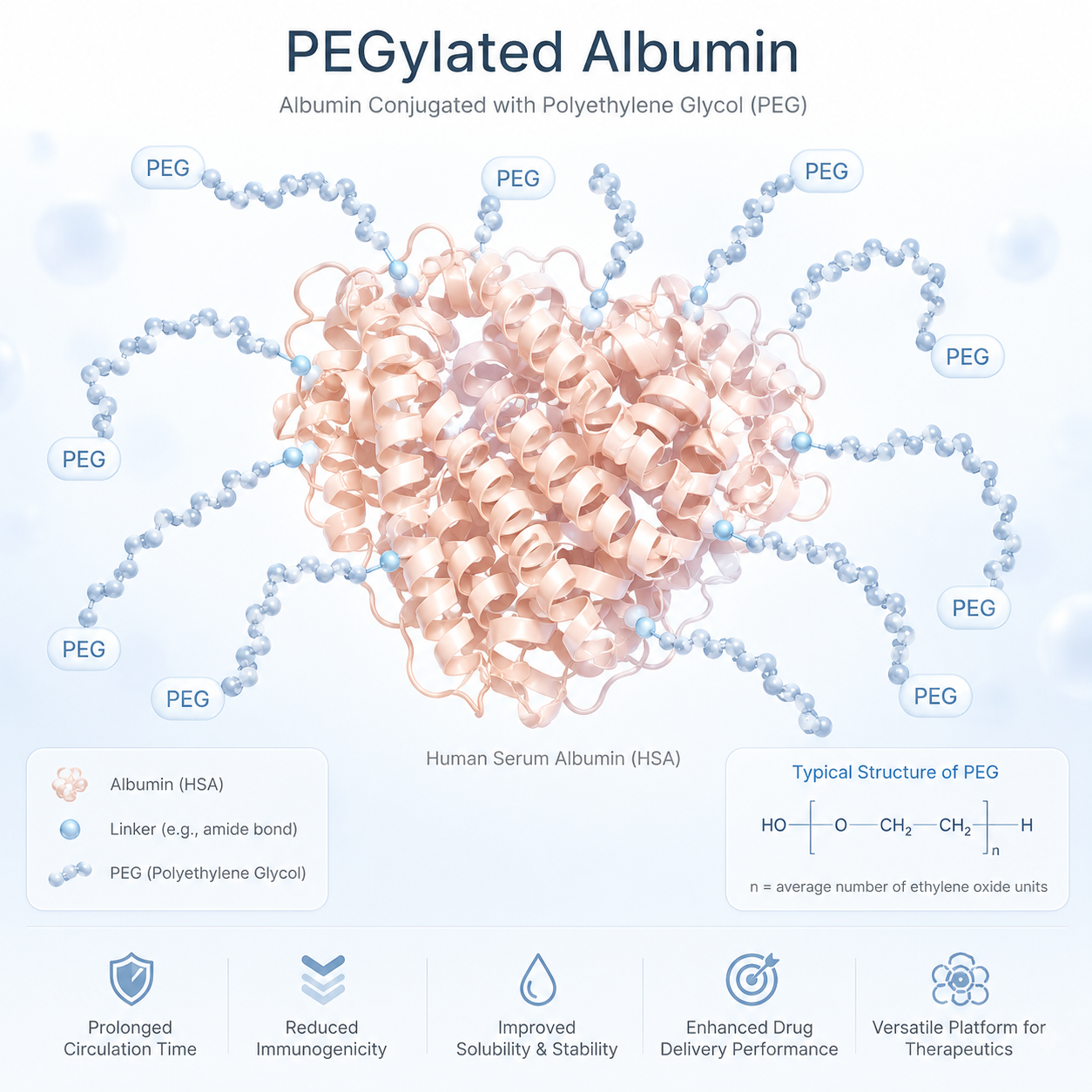
Description
General Description
PEGylated Bovine Serum Albumin (PEG-BSA) is a protein-polymer conjugate in which one or more polyethylene glycol (PEG) chains are covalently attached to bovine serum albumin (BSA).
BSA is one of the most widely used model proteins in biochemical, pharmaceutical, and biomaterials research because of its well-characterized structure, high aqueous solubility, stability, and multiple accessible functional groups for chemical modification.
PEGylation increases the hydrodynamic size of BSA and modifies its surface properties. Depending on PEG molecular weight, PEG architecture, conjugation chemistry, and degree of PEGylation, PEG-BSA can exhibit altered solubility, aggregation behavior, proteolytic stability, surface adsorption, and biological interactions.
PEG-BSA is particularly useful as a model PEGylated protein for developing and evaluating PEGylation chemistry, analytical methods, protein-polymer conjugates, nanoparticle systems, hydrogels, surface coatings, and drug delivery platforms.
Different PEG molecular weights and degrees of PEGylation can be prepared to meet specific research requirements.
Applications
- Protein PEGylation research
- Model PEGylated protein
- PEGylation method development
- Protein-polymer conjugate research
- Drug delivery studies
- Nanoparticle formulation
- Protein stabilization studies
- Surface modification
- Hydrogel and biomaterials research
- Analytical method development
Features and Benefits
- PEGylated bovine serum albumin
- Well-characterized model protein
- Increased hydrodynamic size after PEGylation
- Improved steric stabilization
- Reduced tendency toward aggregation
- Tunable PEG molecular weight
- Tunable degree of PEGylation
- Custom PEGylation available