DSPA

Price range: $160.00 through $1,600.00

DSPA (1,2-Distearoyl-sn-glycero-3-phosphate, sodium salt; 18:0 PA) is a synthetic phosphatidic acid lipid containing two saturated stearoyl (C18:0) chains and a negatively charged phosphate head group. DSPA is widely used in liposome preparation, lipid nanoparticle formulation, membrane biophysics studies, drug delivery research, and lipid-protein interaction investigations.

Product Specifications

Product Name: DSPA
Chemical Name: 1,2-Distearoyl-sn-glycero-3-phosphate, sodium salt
Abbreviation: DSPA (18:0 PA)
Molecular Weight: 726.98 
Cas#:  108321-18-2
Appearance: White to off-white powder
Solubility: Chloroform, Methanol, Chloroform/Methanol mixtures
Storage: -20°C, dry and protected from light
Purity: 97%

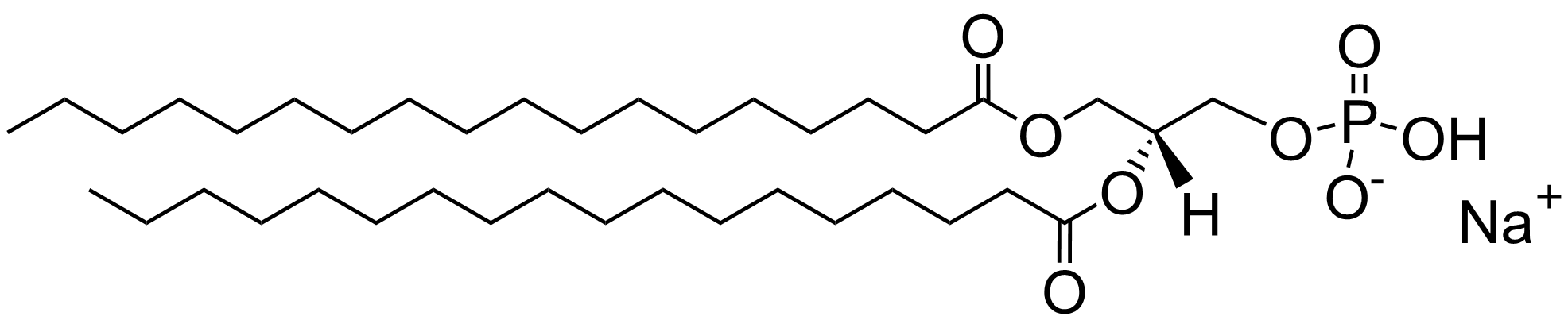
DSPA structure


SKU: 13945 Categories: , ,

Product Details

CAS No. : 18194-24-6
Formula : C36H72NO8P
M.W : 677.93
SMILES Code : CCCCCCCCCCCCCC(O[C@@H](COP([O-])(OCC[N+](C)(C)C)=O)COC(CCCCCCCCCCCCC)=O)=O
Synonyms :
DMPC; Dimyristoyl phosphatidylcholine; 1,2-Dimyristoyl-sn-glycero-3-phosphorylcholine
English Name : (R)-2,3-Bis(tetradecanoyloxy)propyl (2-(trimethylammonio)ethyl) phosphate
MDL No. : MFCD00036901
InChI Key : CITHEXJVPOWHKC-UUWRZZSWSA-N
Pubchem ID : 5459377

Description

DSPA is an anionic phospholipid belonging to the phosphatidic acid (PA) family. It consists of two stearic acid (C18:0) chains esterified to a glycerol backbone and a phosphate head group present as the sodium salt.

Phosphatidic acid lipids play important roles in membrane structure, membrane fusion, signaling pathways, and vesicle trafficking. Due to its fully saturated acyl chains, DSPA exhibits high membrane stability and is frequently employed in liposome formulation, membrane model systems, pharmaceutical formulations, and nanomedicine research.

DSPA serves as a valuable lipid reagent for studying membrane dynamics, lipid-protein interactions, and lipid-based drug delivery systems.


Applications

  • Liposome formulation
  • Lipid nanoparticle (LNP) research
  • Model membrane preparation
  • Membrane fusion studies
  • Lipid-protein interaction studies
  • Drug delivery research
  • Lipid metabolism research
  • Cell membrane biophysics
  • Nanomedicine development
  • Pharmaceutical formulation research

Features and Benefits

  • Synthetic phosphatidic acid lipid
  • Negatively charged phospholipid
  • Fully saturated C18:0 acyl chains
  • High membrane stability
  • Suitable for liposome preparation
  • Useful for membrane biophysics studies
  • Compatible with lipid nanoparticle formulations
  • Excellent batch-to-batch consistency

Additional information

Package Size

100mg, 200mg, 500mg, 1g, 5g