

Description
General Description
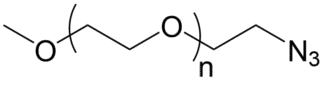
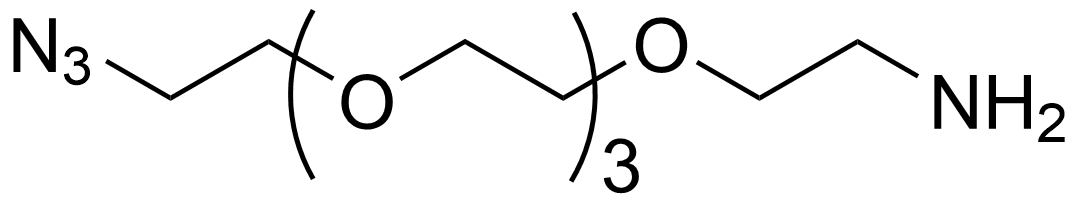
Azide-dPEG4-Amine (N₃-dPEG4-NH₂) is a heterobifunctional discrete polyethylene glycol linker containing an azide (N₃) at one end and a primary amine (NH₂) at the other, separated by a defined PEG4 spacer.
Unlike conventional polydisperse PEG polymers, dPEG linkers have a defined chain length and molecular structure. The PEG4 spacer provides hydrophilicity and controlled spatial separation between the two reactive groups.
The terminal azide participates in copper(I)-catalyzed azide-alkyne cycloaddition (CuAAC) with terminal alkynes and strain-promoted azide-alkyne cycloaddition (SPAAC) with strained cyclooctynes such as DBCO and BCN.
The primary amine provides an independent reactive site for conjugation with NHS esters, activated carboxylic acids, aldehydes, and other amine-reactive compounds. These orthogonal functionalities make N₃-dPEG4-NH₂ useful for sequential conjugation and the construction of well-defined molecular conjugates.
Applications
- CuAAC click chemistry
- Copper-free SPAAC click chemistry
- Bioconjugation
- Protein and peptide modification
- Antibody conjugation
- Drug conjugation
- Linker synthesis
- Fluorescent probe conjugation
- Nanoparticle functionalization
- Surface modification
- PROTAC and molecular linker research
Features and Benefits
- Defined dPEG4 spacer
- Heterobifunctional azide and amine termini
- Compatible with CuAAC
- Compatible with copper-free SPAAC
- Primary amine for NHS ester coupling
- Hydrophilic PEG spacer
- Suitable for orthogonal conjugation
- Defined molecular structure
- Useful for multistep bioconjugation