

Description
General Description
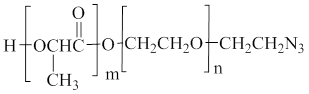
PLLA-PEG-Azide (PLLA-PEG-N₃) is a heterobifunctional biodegradable block copolymer consisting of poly(L-lactide) (PLLA), a hydrophilic polyethylene glycol (PEG) spacer, and a terminal azide (N₃) functional group.
The hydrophobic PLLA block provides a biodegradable polymer domain suitable for forming polymeric nanoparticles, micelles, and other self-assembled nanostructures. The PEG segment improves aqueous dispersibility and colloidal stability while presenting the reactive azide functionality at the surface of the resulting nanocarrier.
The terminal azide group can react with alkynes through copper-catalyzed azide-alkyne cycloaddition (CuAAC) or with strained cyclooctynes such as DBCO and BCN through strain-promoted azide-alkyne cycloaddition (SPAAC). SPAAC proceeds without a copper catalyst and is particularly useful for bioorthogonal conjugation in biological systems.
PLLA-PEG-N₃ provides a versatile platform for attaching peptides, proteins, antibodies, targeting ligands, fluorophores, drugs, and other functional molecules to biodegradable polymeric nanoparticles and biomaterials.
Applications
- Polymeric nanoparticle preparation
- Polymeric micelle formation
- Click chemistry conjugation
- CuAAC click chemistry
- SPAAC copper-free click chemistry
- Protein and peptide conjugation
- Antibody conjugation
- Targeting ligand attachment
- Nanoparticle surface functionalization
- Targeted drug delivery
- Biomaterials research
Features and Benefits
- Biodegradable PLLA block
- Hydrophilic PEG spacer
- Terminal azide functionality
- Compatible with CuAAC click chemistry
- Compatible with copper-free SPAAC chemistry
- Reactive with alkyne, DBCO, and BCN groups
- Suitable for bioorthogonal conjugation
- Self-assembly into nanoparticles and micelles
- Tunable PLLA and PEG molecular weights