
Description
General Description
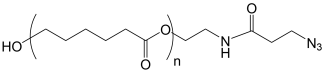
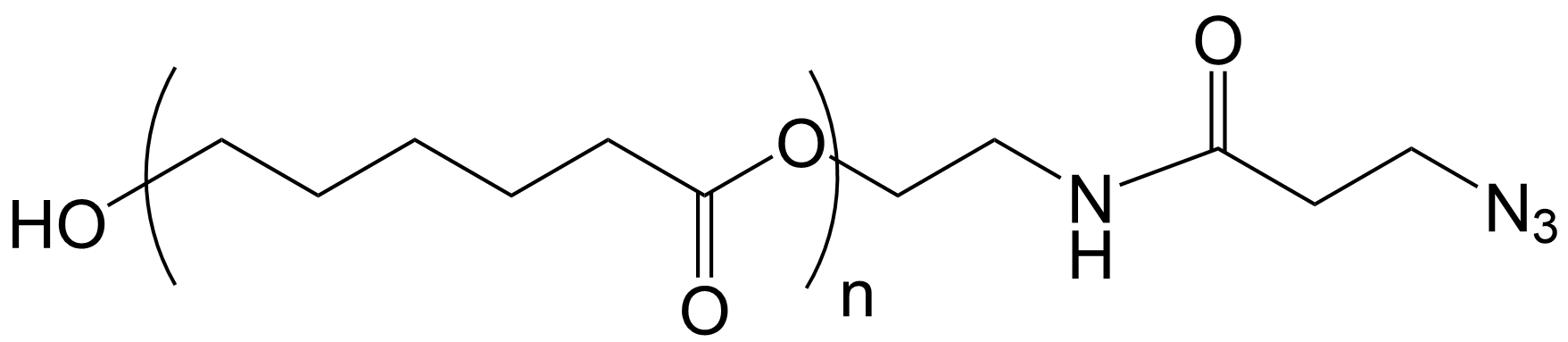
PCL-Azide (PCL-N₃), also known as azide-functionalized poly(ε-caprolactone) or azido-PCL, is a biodegradable polyester containing a terminal azide (N₃) functional group.
Poly(ε-caprolactone) (PCL) is a hydrophobic, biodegradable aliphatic polyester widely used in biomaterials, polymeric nanoparticles, and drug delivery research. Introduction of a terminal azide provides a bioorthogonal reactive site for further modification of the PCL chain.
The terminal azide participates in copper(I)-catalyzed azide-alkyne cycloaddition (CuAAC) with terminal alkynes and strain-promoted azide-alkyne cycloaddition (SPAAC) with strained cyclooctynes such as DBCO and BCN.
PCL-N₃ can therefore serve as a versatile building block for preparing functional polymers, polymer-drug conjugates, ligand-functionalized nanoparticles, fluorescent polymer conjugates, and amphiphilic block copolymers.
Applications
- CuAAC click chemistry
- Copper-free SPAAC click chemistry
- Polymer conjugation
- Nanoparticle preparation
- Nanoparticle surface functionalization
- Drug delivery research
- Block copolymer synthesis
- Polymer-drug conjugates
- Ligand conjugation
- Fluorescent probe conjugation
- Biomaterials research
Features and Benefits
- Terminal azide (N₃) functionality
- Biodegradable PCL backbone
- Hydrophobic polyester segment
- Compatible with CuAAC
- Compatible with copper-free SPAAC
- Reactive with terminal alkynes, DBCO, and BCN
- Suitable for bioorthogonal polymer functionalization
- Useful for block copolymer synthesis
- Multiple molecular weights available
- Custom molecular weights available