
Description
General Description
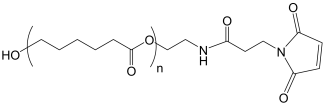
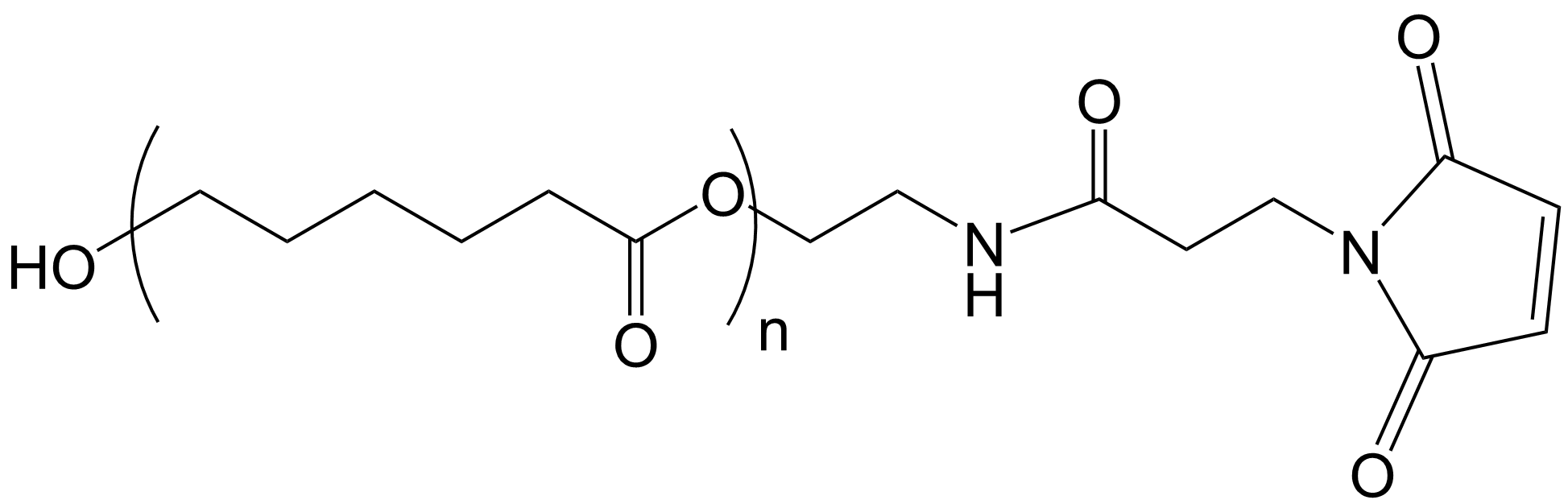
PCL-Maleimide (PCL-MAL), also known as maleimide-functionalized poly(ε-caprolactone), is a biodegradable PCL polymer containing a terminal maleimide (MAL) functional group.
Poly(ε-caprolactone) (PCL) is a hydrophobic, biodegradable aliphatic polyester widely used in biomaterials, polymeric nanoparticles, controlled-release systems, and drug delivery research. Introduction of a terminal maleimide provides a reactive site for conjugation with thiol-containing molecules.
Maleimide reacts efficiently with thiols (SH), including cysteine residues in peptides and proteins, to form stable thioether linkages. This chemistry makes PCL-MAL useful for preparing ligand-functionalized polymers, polymer-protein conjugates, targeted nanoparticles, and other functional biodegradable materials.
Applications
- Thiol-maleimide conjugation
- Protein and peptide modification
- Cysteine-selective conjugation
- Polymer conjugation
- Nanoparticle preparation
- Nanoparticle surface functionalization
- Drug delivery research
- Ligand conjugation
- Polymer-drug conjugates
- Biomaterials research
- Functional block copolymer synthesis
Features and Benefits
- Terminal maleimide functionality
- Thiol-reactive polymer
- Biodegradable PCL backbone
- Hydrophobic polyester segment
- Suitable for cysteine-containing peptides and proteins
- Forms stable thioether linkages
- Useful for nanoparticle functionalization
- Suitable for polymer bioconjugation
- Multiple molecular weights available
- Custom molecular weights available