
Description
General Description
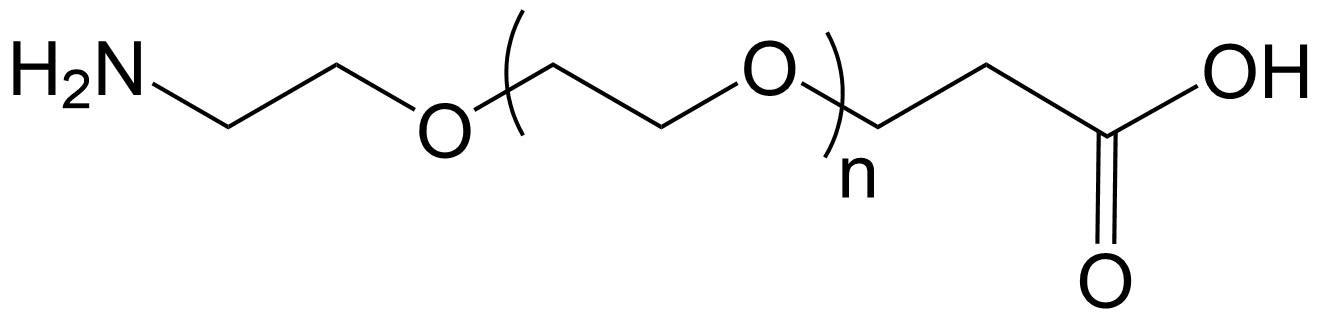
NH2-PEG-Propionic Acid is a versatile heterobifunctional PEG linker designed for orthogonal bioconjugation and polymer functionalization. The terminal primary amine efficiently reacts with activated esters, aldehydes, isothiocyanates, epoxides, and other electrophilic functional groups, enabling selective conjugation to proteins, peptides, antibodies, polymers, nanoparticles, and biomaterial surfaces.
The terminal propionic acid provides a carboxyl functionality separated from the PEG chain by a short three-carbon spacer. It can be activated using carbodiimide chemistry (EDC/NHS) or peptide coupling reagents such as HATU or HBTU to form stable amide bonds with primary amines. The additional propionic spacer can reduce steric hindrance during conjugation and improve accessibility of the reactive carboxyl group.
The hydrophilic PEG spacer enhances water solubility, molecular flexibility, and biocompatibility while minimizing nonspecific protein adsorption. NH2-PEG-Propionic Acid is widely employed in protein conjugation, peptide synthesis, hydrogel preparation, nanoparticle engineering, targeted drug delivery, and advanced biomaterials development.
Applications
- Protein conjugation
- Peptide synthesis
- Polymer synthesis
- PEG linker synthesis
- Surface modification
- Nanoparticle functionalization
- Hydrogel synthesis
- Drug delivery systems
- Biomaterials engineering
- Biomedical research
Features and Benefits
- Terminal primary amine
- Terminal propionic acid functionality
- Compatible with EDC/NHS coupling
- Efficient amine conjugation
- Reduced steric hindrance
- Excellent water solubility
- Excellent biocompatibility
- Versatile synthetic intermediate
- Available in multiple PEG molecular weights