


Description
General Description
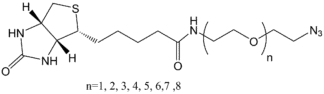
Azide-dPEG-Amine (N₃-dPEG-NH₂) includes heterobifunctional discrete polyethylene glycol (dPEG) linkers containing a terminal azide (N₃) group and a primary amine (NH₂) group. These linkers combine two orthogonal reactive functionalities with precisely defined PEG spacer lengths, making them useful for click chemistry, bioconjugation, protein and peptide modification, drug conjugation, and linker synthesis.
The azide group reacts with terminal alkynes through copper(I)-catalyzed azide-alkyne cycloaddition (CuAAC) or with strained cyclooctynes such as DBCO and BCN through copper-free strain-promoted azide-alkyne cycloaddition (SPAAC).
The primary amine provides an independent reactive site for NHS esters, activated carboxylic acids, aldehydes, and other amine-reactive compounds.
Unlike conventional polydisperse PEGs, dPEG linkers have defined PEG chain lengths and molecular structures, providing precise control over spacer length and molecular composition. Available Azide-dPEG-Amine products include different discrete PEG lengths for selecting the appropriate spacing for specific conjugation applications.
Applications
- CuAAC click chemistry
- Copper-free SPAAC click chemistry
- Bioconjugation
- Protein and peptide modification
- Antibody conjugation
- Drug conjugation
- PROTAC linker synthesis
- Fluorescent probe conjugation
- Nanoparticle functionalization
- Surface modification
- Heterobifunctional linker synthesis
Features and Benefits
- Discrete PEG (dPEG) structure
- Precisely defined PEG spacer length
- Terminal azide (N₃)
- Terminal primary amine (NH₂)
- Heterobifunctional and orthogonal chemistry
- Compatible with CuAAC and SPAAC
- Reactive with DBCO, BCN, and terminal alkynes
- Amine suitable for NHS ester coupling
- Hydrophilic PEG spacer
- Multiple dPEG lengths available