


Description
General Description
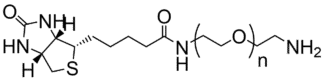
Biotin-PEG-NH2 (BIO-PEG-NH2) is a versatile heterobifunctional PEG reagent designed for affinity-based bioconjugation and surface modification. The biotin group binds with exceptionally high affinity to streptavidin and avidin, enabling efficient immobilization, purification, detection, and targeting of biomolecules.
The terminal primary amine readily reacts with activated carboxylic acids (via EDC/NHS coupling), aldehydes, epoxides, isothiocyanates, activated esters, and other amine-reactive functional groups. The hydrophilic PEG spacer enhances water solubility, reduces steric hindrance, minimizes nonspecific protein adsorption, and improves the accessibility of both the biotin and amine functionalities.
Biotin-PEG-NH2 is widely employed in antibody conjugation, peptide synthesis, enzyme immobilization, nanoparticle engineering, biosensor fabrication, targeted drug delivery, molecular imaging, and advanced biomaterials development.
Applications
- Protein conjugation
- Antibody labeling
- Peptide conjugation
- Streptavidin-based assays
- Enzyme immobilization
- Nanoparticle functionalization
- Surface modification
- Biosensor fabrication
- Drug delivery systems
- Biomedical research
Features and Benefits
- Heterobifunctional PEG linker
- High-affinity biotin functionality
- Reactive primary amine group
- Excellent water solubility
- Reduced steric hindrance
- Improved bioconjugation efficiency
- Excellent biocompatibility
- Compatible with multiple coupling chemistries
- Available in multiple PEG molecular weights