


Description
General Description
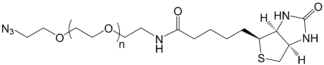
N3-PEG-Biotin is a versatile heterobifunctional PEG linker designed for bioorthogonal conjugation and affinity-based bioconjugation. The terminal azide group readily participates in copper-catalyzed azide-alkyne cycloaddition (CuAAC) with terminal alkynes and strain-promoted azide-alkyne cycloaddition (SPAAC) with strained alkynes such as DBCO and BCN, enabling rapid and highly selective conjugation under mild conditions.
The terminal biotin group exhibits extremely high affinity for streptavidin and avidin (Kd ≈ 10⁻¹⁵ M), making it ideal for protein immobilization, affinity purification, biosensor fabrication, targeted delivery, and diagnostic assays.
The hydrophilic PEG spacer enhances water solubility, molecular flexibility, and biocompatibility while reducing steric hindrance and minimizing nonspecific protein adsorption. N3-PEG-Biotin is extensively employed for click chemistry, nanoparticle functionalization, surface modification, molecular imaging, targeted therapeutics, and advanced biomaterials development.
Applications
- Click chemistry (CuAAC)
- Copper-free click chemistry (SPAAC)
- Streptavidin-based assays
- Protein labeling
- Affinity purification
- Surface modification
- Nanoparticle functionalization
- Molecular imaging
- Drug delivery systems
- Biomaterials research
Features and Benefits
- Reactive azide group
- High-affinity biotin functionality
- Compatible with CuAAC click chemistry
- Compatible with SPAAC chemistry
- Excellent water solubility
- Excellent biocompatibility
- Reduced steric hindrance
- Low nonspecific protein adsorption
- Available in multiple PEG molecular weights

Reviews
There are no reviews yet.