
Description
General Description
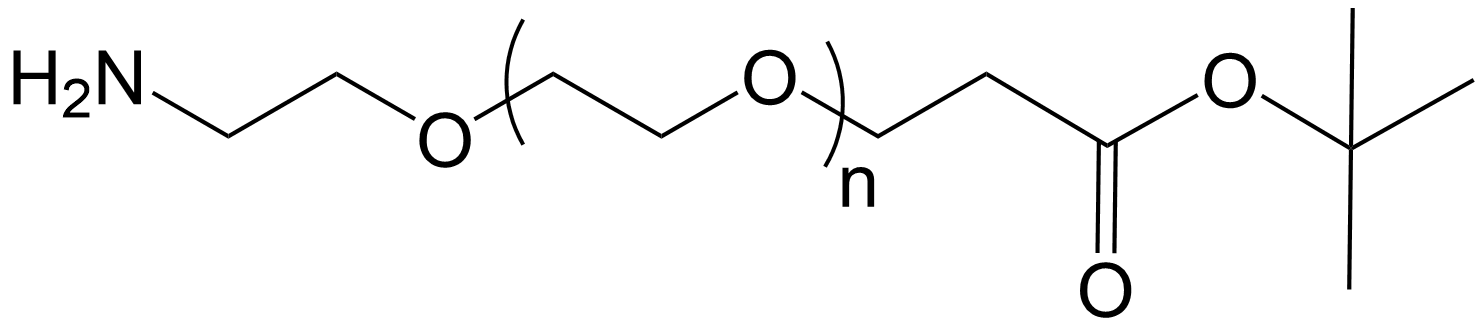
NH2-PEG-Propionic Acid tert-Butyl Ester is a versatile heterobifunctional PEG building block designed for orthogonal synthetic strategies. The terminal primary amine readily reacts with activated esters, aldehydes, isothiocyanates, epoxides, and other electrophilic functional groups, enabling efficient conjugation to proteins, peptides, antibodies, polymers, nanoparticles, and biomaterial surfaces.
The opposite terminus contains a propionic acid protected as a tert-butyl ester. This protecting group is stable under neutral and basic conditions but can be readily removed using acidic reagents such as trifluoroacetic acid (TFA) to generate NH2-PEG-Propionic Acid, providing a free carboxylic acid for subsequent EDC/NHS coupling or peptide coupling reactions.
The hydrophilic PEG spacer enhances aqueous solubility, molecular flexibility, and biocompatibility while reducing steric hindrance and minimizing nonspecific interactions. This compound is widely used as a synthetic intermediate for multifunctional PEG derivatives, targeted drug delivery systems, peptide synthesis, and advanced biomaterials.
Applications
- Peptide synthesis
- Polymer synthesis
- PEG linker synthesis
- Protein conjugation
- Surface modification
- Nanoparticle functionalization
- Drug delivery systems
- Hydrogel synthesis
- Biomaterials engineering
- Biomedical research
Features and Benefits
- Terminal primary amine
- tert-Butyl ester-protected propionic acid
- Acid-labile protecting group
- Selective deprotection to NH2-PEG-Propionic Acid
- Excellent water solubility
- Excellent biocompatibility
- Orthogonal functionalization
- Versatile synthetic intermediate
- Available in multiple PEG molecular weights