
Description
General Description
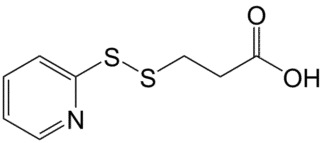
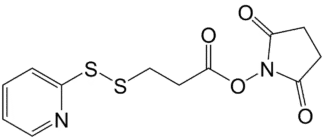
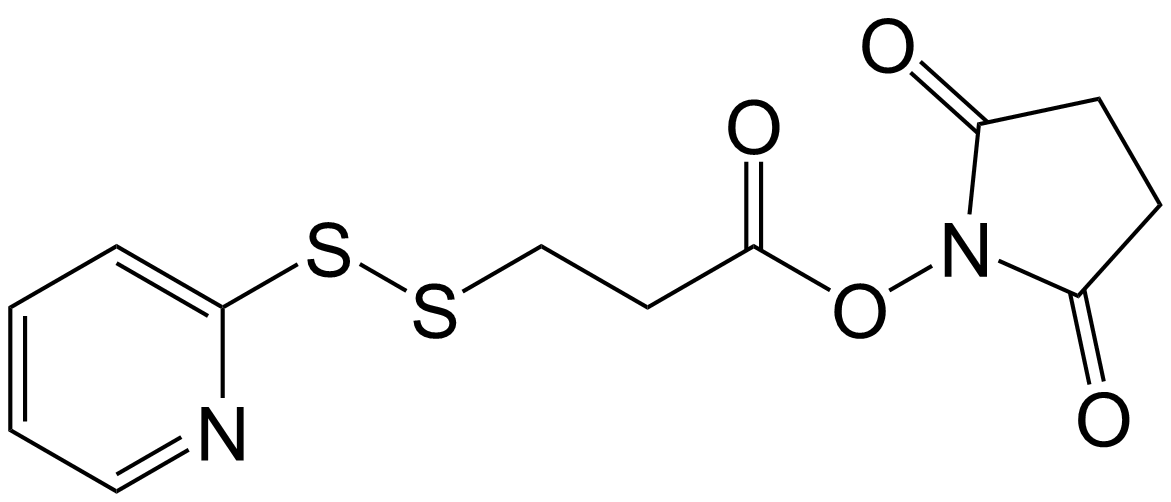
SPDP is one of the most widely used heterobifunctional crosslinkers for constructing reversible bioconjugates. The molecule contains two orthogonal reactive groups: an N-hydroxysuccinimide (NHS) ester that efficiently reacts with primary amines and a 2-pyridyl disulfide (PDP) group that selectively reacts with sulfhydryl groups.
The NHS ester readily couples to lysine residues on proteins, peptides, antibodies, enzymes, polymers, and nanoparticles under mild aqueous conditions, forming stable amide bonds. The pyridyl disulfide moiety subsequently undergoes thiol-disulfide exchange with cysteine-containing biomolecules, releasing pyridine-2-thione and generating a cleavable disulfide linkage.
Because the disulfide bond can be reduced intracellularly by glutathione (GSH) or other reducing agents, SPDP is widely employed for preparing redox-responsive conjugates, antibody-drug conjugates (ADCs), PEGylated biomolecules, protein immobilization, nanoparticle surface modification, and targeted drug delivery systems.
Applications
- Protein conjugation
- Antibody modification
- PEGylation
- Thiol-selective conjugation
- Antibody-drug conjugates (ADCs)
- Drug delivery systems
- Nanoparticle functionalization
- Protein immobilization
- Surface modification
- Biomaterials research
Features and Benefits
- Heterobifunctional crosslinker
- NHS ester for amine conjugation
- Pyridyl disulfide for thiol conjugation
- Orthogonal conjugation chemistry
- Cleavable disulfide linkage
- Redox-responsive linker
- High coupling efficiency
- Research-grade quality