
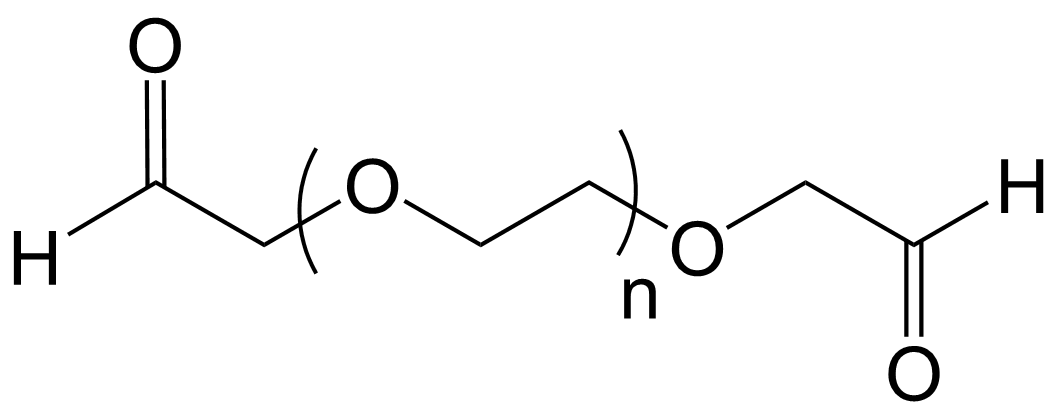
Description
General Description
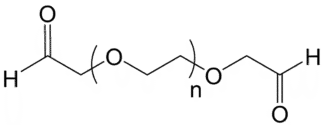
ALD-PEG-ALD is a versatile homobifunctional PEG crosslinker designed for covalent immobilization and hydrogel formation. Both terminal aldehyde groups readily react with primary amines under mild conditions to form reversible Schiff base (imine) linkages, which can be stabilized by reductive amination when permanent conjugation is desired.
The aldehyde groups also react efficiently with hydrazide- and aminooxy-functionalized molecules to form stable hydrazone and oxime bonds, respectively. These bioorthogonal reactions are widely employed for hydrogel fabrication, protein immobilization, surface functionalization, and bioconjugation.
The hydrophilic PEG backbone enhances water solubility, molecular flexibility, and biocompatibility while reducing steric hindrance and minimizing nonspecific protein adsorption. ALD-PEG-ALD is extensively used in injectable hydrogels, tissue engineering, regenerative medicine, biosensors, drug delivery systems, and advanced biomaterials.
Applications
- Hydrogel synthesis
- Protein crosslinking
- Protein immobilization
- Tissue engineering
- Surface modification
- Injectable hydrogels
- Drug delivery systems
- Biosensor fabrication
- Regenerative medicine
- Biomaterials research
Features and Benefits
- Homobifunctional PEG crosslinker
- Two reactive aldehyde groups
- Compatible with reductive amination
- Forms Schiff base, hydrazone, and oxime linkages
- Excellent water solubility
- Excellent biocompatibility
- Flexible PEG spacer
- Low nonspecific protein adsorption
- Available in multiple PEG molecular weights