
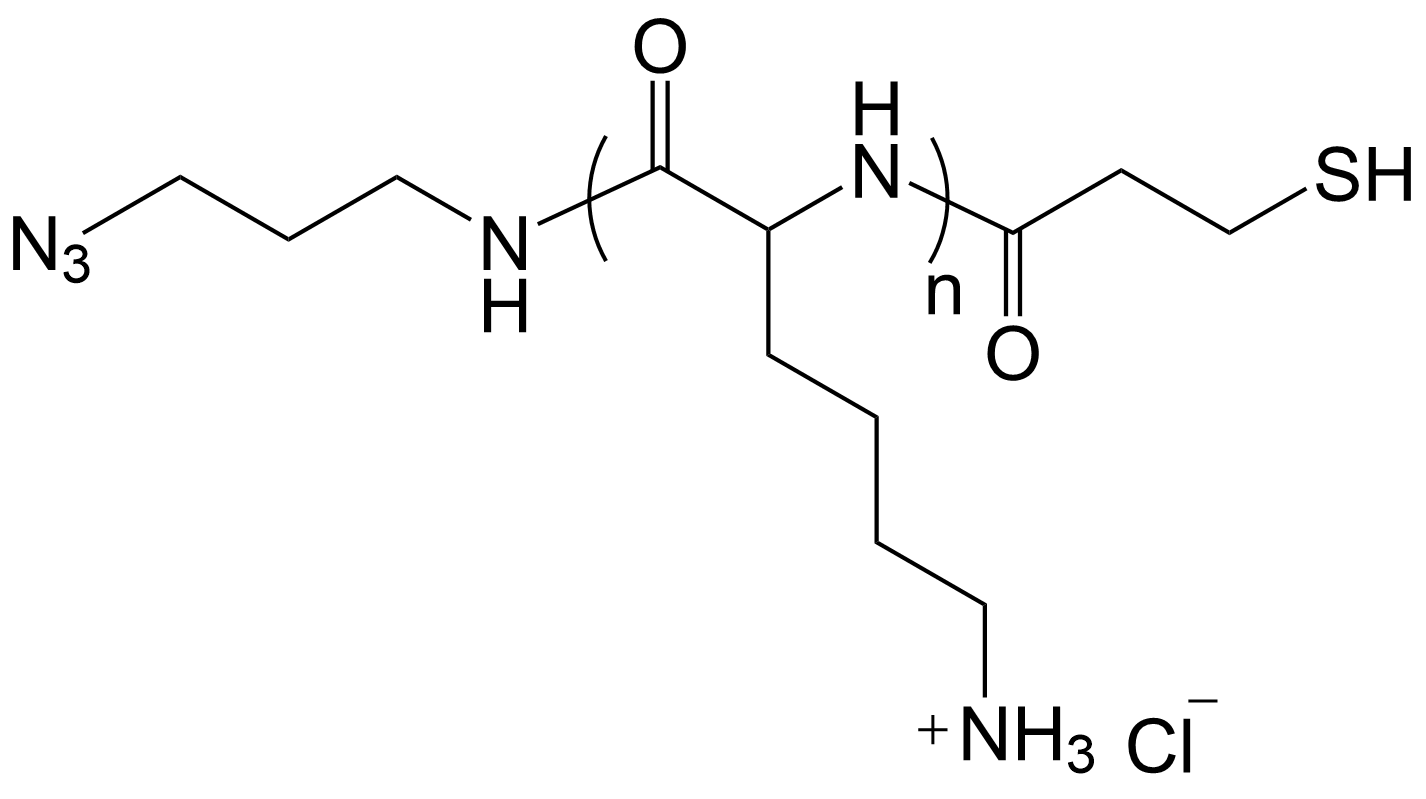
Description
General Description
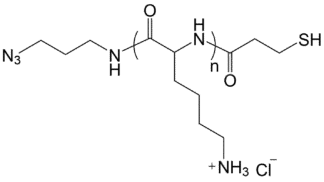
Azide-Poly(L-Lysine)-Thiol is a multifunctional biodegradable polypeptide designed for orthogonal bioconjugation and advanced drug delivery applications. The terminal azide group participates in copper-catalyzed azide-alkyne cycloaddition (CuAAC) and strain-promoted azide-alkyne cycloaddition (SPAAC) with strained alkynes such as DBCO and BCN. The terminal thiol group reacts selectively with maleimides through thiol-maleimide coupling, participates in thiol-ene reactions, forms reversible disulfide bonds, and can be immobilized directly onto gold surfaces.
The poly(L-lysine) backbone contains multiple primary amine groups that readily complex with negatively charged nucleic acids, including DNA, RNA, siRNA, and mRNA. These amine groups also serve as reactive sites for conjugation with NHS esters, activated carboxylic acids, aldehydes, and other amine-reactive molecules.
The combination of azide, thiol, and cationic poly(L-lysine) functionalities makes N₃-PLL-SH an excellent platform for gene delivery, polymer-drug conjugates, multifunctional nanoparticles, hydrogel preparation, surface engineering, and advanced biomaterials.
Applications
- Click chemistry (CuAAC)
- Copper-free click chemistry (SPAAC)
- Thiol-maleimide conjugation
- Gene delivery
- DNA and RNA complexation
- Nanoparticle functionalization
- Hydrogel synthesis
- Surface modification
- Molecular imaging
- Biomaterials research
Features and Benefits
- Terminal azide functionality
- Terminal thiol functionality
- Orthogonal dual-functional polymer
- Compatible with CuAAC and SPAAC chemistry
- Compatible with thiol-maleimide coupling
- Multiple primary amine groups
- Excellent nucleic acid binding
- Available in multiple molecular weights