


Description
General Description
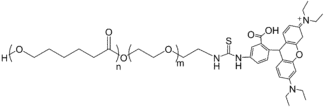
PCL-PEG-Rhodamine B is a multifunctional biodegradable copolymer designed for fluorescence imaging and nanomedicine applications. The hydrophobic poly(ε-caprolactone) (PCL) segment self-assembles into polymeric micelles and nanoparticles capable of encapsulating hydrophobic therapeutics, whereas the hydrophilic polyethylene glycol (PEG) segment improves aqueous dispersibility, colloidal stability, prolonged circulation, and biocompatibility.
The covalently linked Rhodamine B (RhB) fluorophore emits bright red fluorescence, allowing direct visualization of polymeric nanoparticles, biodistribution, cellular uptake, intracellular trafficking, and drug release using fluorescence microscopy, confocal microscopy, and flow cytometry. Because the fluorophore is chemically attached to the polymer backbone, fluorescence remains stable throughout nanoparticle preparation and biological studies.
PCL-PEG-RhB is widely used in targeted drug delivery, nanomedicine, tissue engineering, bioimaging, diagnostic research, and the development of multifunctional fluorescent biomaterials.
Applications
- Fluorescent nanoparticle preparation
- Drug delivery systems
- Cellular uptake studies
- Fluorescence microscopy
- Confocal imaging
- Flow cytometry
- Biodistribution studies
- Tissue engineering
- Polymer tracking
- Biomaterials research
Features and Benefits
- Amphiphilic PCL-PEG block copolymer
- Covalently linked Rhodamine B fluorophore
- Bright red fluorescence
- Biodegradable PCL segment
- Excellent aqueous dispersibility
- Suitable for nanoparticle fabrication
- Enables real-time fluorescence tracking
- Research-grade quality