

Description
General Description
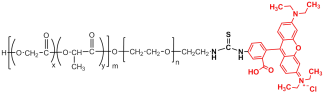
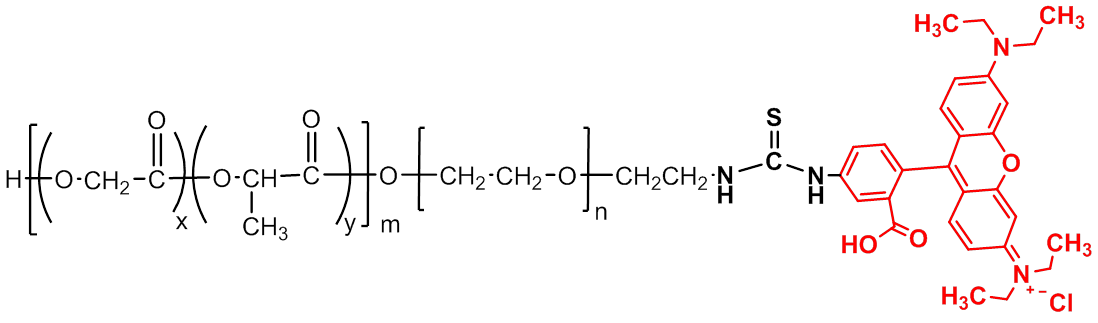
PLGA-PEG-Rhodamine B (PLGA-PEG-RhB) is a fluorescent biodegradable block copolymer consisting of poly(lactic-co-glycolic acid) (PLGA), a hydrophilic polyethylene glycol (PEG) spacer, and a terminal Rhodamine B (RhB) fluorescent group.
The hydrophobic PLGA block provides a biodegradable polymer domain suitable for encapsulation of hydrophobic compounds and formation of polymeric nanoparticles, micelles, and other self-assembled nanostructures. The PEG segment improves aqueous dispersibility and colloidal stability while positioning the fluorescent Rhodamine B group away from the hydrophobic PLGA domain.
Rhodamine B is a widely used fluorescent dye with strong visible fluorescence and is useful for fluorescence microscopy, confocal microscopy, cellular uptake studies, and nanoparticle tracking. Covalent incorporation of RhB into PLGA-PEG provides a fluorescent polymer that can be incorporated directly into nanoparticles, reducing the potential for rapid leakage associated with physically encapsulated fluorescent dyes.
PLGA-PEG-RhB is particularly useful for studying nanoparticle formation, cellular internalization, intracellular trafficking, biodistribution, drug delivery, and interactions between polymeric nanocarriers and biological systems.
Applications
- Fluorescent PLGA nanoparticles
- Polymeric micelle preparation
- Nanoparticle tracking
- Cellular uptake studies
- Fluorescence microscopy
- Confocal microscopy
- Intracellular trafficking studies
- Biodistribution research
- Drug delivery research
- Biomaterials research
Features and Benefits
- Biodegradable PLGA block
- Hydrophilic PEG spacer
- Covalently attached Rhodamine B
- Strong red-orange fluorescence
- Suitable for nanoparticle tracking
- Useful for cellular uptake studies
- Suitable for fluorescence imaging
- Tunable PLGA and PEG molecular weights
- Tunable lactide ratio