


Description
General Description
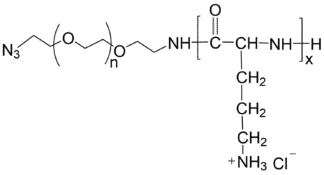
Poly(L-Glutamic Acid)-PEG-N₃ is a multifunctional amphiphilic block copolymer designed for bioorthogonal conjugation and advanced drug delivery applications. The terminal azide group readily participates in copper-catalyzed azide-alkyne cycloaddition (CuAAC) with terminal alkynes and strain-promoted azide-alkyne cycloaddition (SPAAC) with strained alkynes such as DBCO and BCN, allowing highly selective conjugation under mild conditions.
The biodegradable poly(L-glutamic acid) segment contains multiple pendant carboxylic acid groups that can be activated using EDC/NHS chemistry for conjugation with proteins, peptides, antibodies, drugs, nanoparticles, and imaging agents. The PEG segment improves water solubility, biocompatibility, circulation time, and reduces nonspecific protein adsorption.
The combination of a biodegradable pGlu block, a hydrophilic PEG spacer, and a terminal azide group makes pGlu-PEG-N₃ an excellent material for polymer-drug conjugates, targeted nanoparticles, hydrogels, molecular imaging, and advanced biomaterials.
Applications
- Click chemistry (CuAAC)
- Copper-free click chemistry (SPAAC)
- Drug conjugation
- Polymer-drug conjugates
- Nanoparticle functionalization
- Hydrogel synthesis
- Protein and peptide conjugation
- Surface modification
- Molecular imaging
- Biomaterials research
Features and Benefits
- Terminal azide functionality
- Amphiphilic block copolymer
- Biodegradable poly(L-glutamic acid) segment
- Hydrophilic PEG spacer
- Multiple pendant carboxylic acid groups
- Compatible with CuAAC and SPAAC chemistry
- Compatible with EDC/NHS coupling
- Available in multiple polymer compositions