
Description
General Description
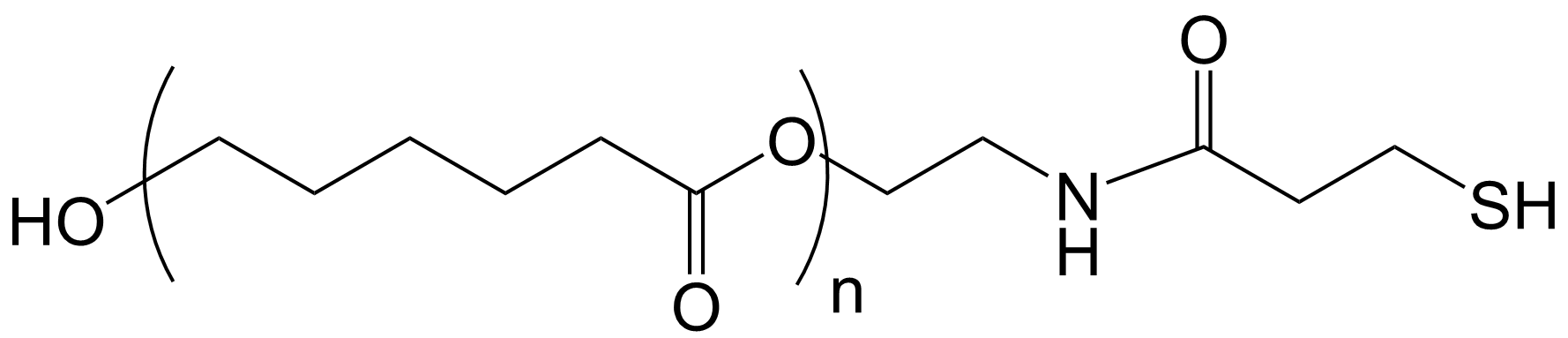
Thiol-Poly(ε-caprolactone) (PCL-SH) is a thiol-functionalized poly(ε-caprolactone) containing a reactive sulfhydryl (–SH) group at the polymer chain end.
Poly(ε-caprolactone) (PCL) is a hydrophobic, biodegradable aliphatic polyester widely used in drug delivery, tissue engineering, regenerative medicine, and biomaterials research. Its relatively slow hydrolytic degradation compared with many lactide- and glycolide-based polyesters makes PCL particularly useful for sustained-release formulations and longer-term biodegradable materials.
The terminal thiol group provides a versatile site for further functionalization. PCL-SH can react with maleimide-functionalized compounds to form stable thioether linkages and can also participate in reactions with vinyl sulfones and activated disulfides. Thiol functionality is additionally useful for attachment to gold and other thiol-reactive surfaces.
PCL-SH can be used as a precursor for functional polymers, polymer-bioconjugates, modified nanoparticles, block copolymers, surface coatings, and other advanced biomaterials.
Applications
- Polymer conjugation
- Thiol-maleimide conjugation
- Nanoparticle functionalization
- Gold surface modification
- Block copolymer synthesis
- Drug delivery
- Controlled release
- Surface modification
- Tissue engineering
- Biomaterials research
Features and Benefits
- Terminal thiol (–SH) functionality
- Biodegradable PCL backbone
- Compatible with maleimide-thiol conjugation
- Reactive with vinyl sulfone groups
- Suitable for disulfide exchange chemistry
- Suitable for gold surface attachment
- Tunable molecular weight
- Versatile precursor for functional PCL materials