
Technical Data
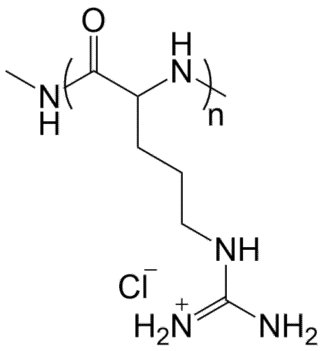
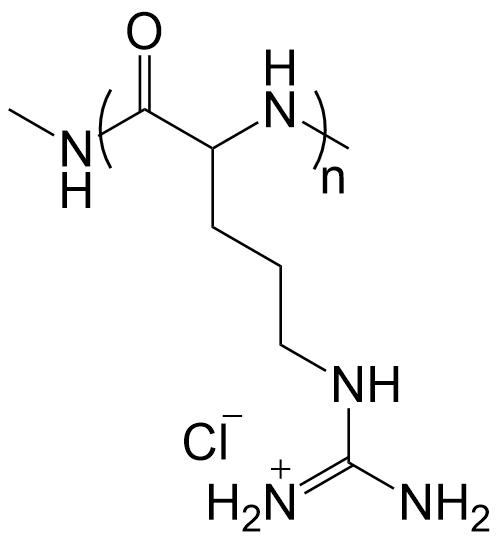
Chemical name: poly(L-arginine hydrochloride)
CAS number: 26982-20-7
Appearance (color) White to faint yellow
Polymerization degree Molecular Weight (Da)
n=10 1,900
n=20 3,800
n=30 5,800
n=50 9,500
n=100 19K
n=200 38K
Price range: $360.00 through $1,600.00
Poly(L-Arginine) (PLAr) is a cationic polypeptide composed of repeating L-arginine residues. Due to its high density of positively charged guanidinium groups, Poly(L-Arginine) exhibits strong interactions with nucleic acids, proteins, cell membranes, and negatively charged biomaterials. It is widely used in gene delivery, cell culture, nanoparticle formulation, surface coating, tissue engineering, and biomedical research.
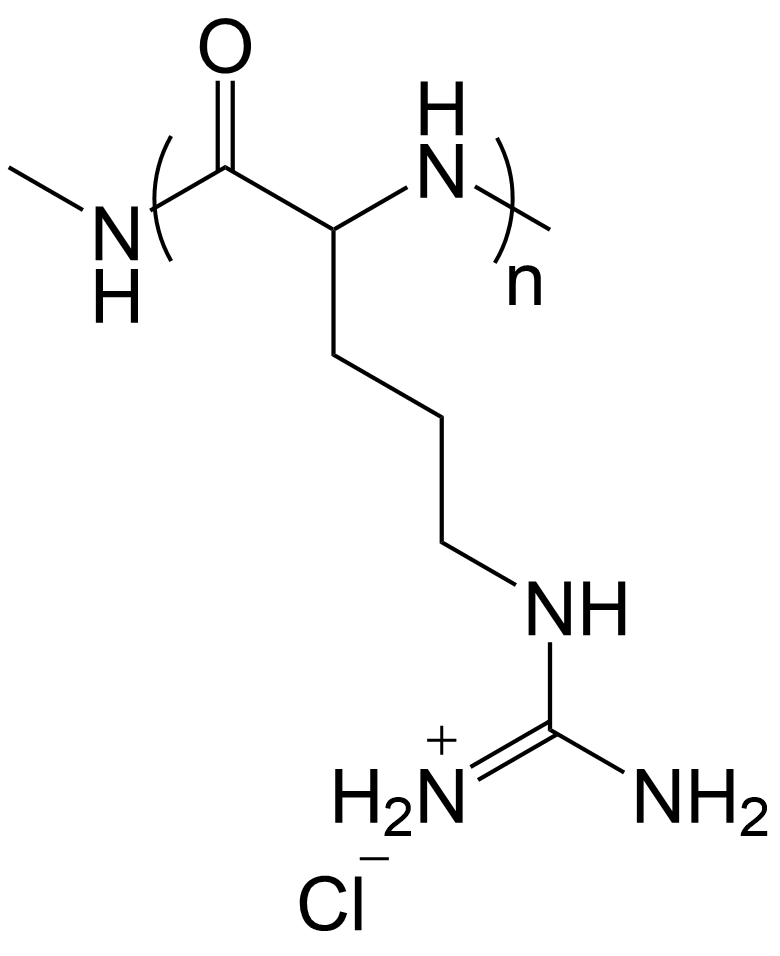
Chemical name: poly(L-arginine hydrochloride)
CAS number: 26982-20-7
Appearance (color) White to faint yellow
Polymerization degree Molecular Weight (Da)
n=10 1,900
n=20 3,800
n=30 5,800
n=50 9,500
n=100 19K
n=200 38K
Poly(L-Arginine) is a synthetic polyamino acid derived from the amino acid L-arginine. The polymer contains guanidinium-functional side chains that remain positively charged under physiological conditions, providing strong electrostatic interactions with negatively charged molecules and biological surfaces.
Compared with poly(L-lysine), Poly(L-Arginine) often exhibits enhanced cellular uptake due to the unique membrane-translocating properties of guanidinium groups. This characteristic makes Poly(L-Arginine) particularly attractive for gene delivery, intracellular transport, cell-penetrating systems, and nanomedicine applications.
Poly(L-Arginine) is frequently utilized for DNA and RNA complexation, nanoparticle surface modification, tissue engineering scaffolds, cell adhesion studies, antimicrobial coatings, and biomaterials development.
| Molecular Weight | 1900, 3800, 5800, 9500, 19K, 38K |
|---|---|
| Package Size | 100mg, 200mg, 500mg, 1g |