

Description
General Description
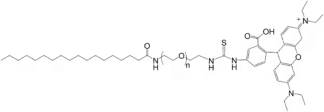
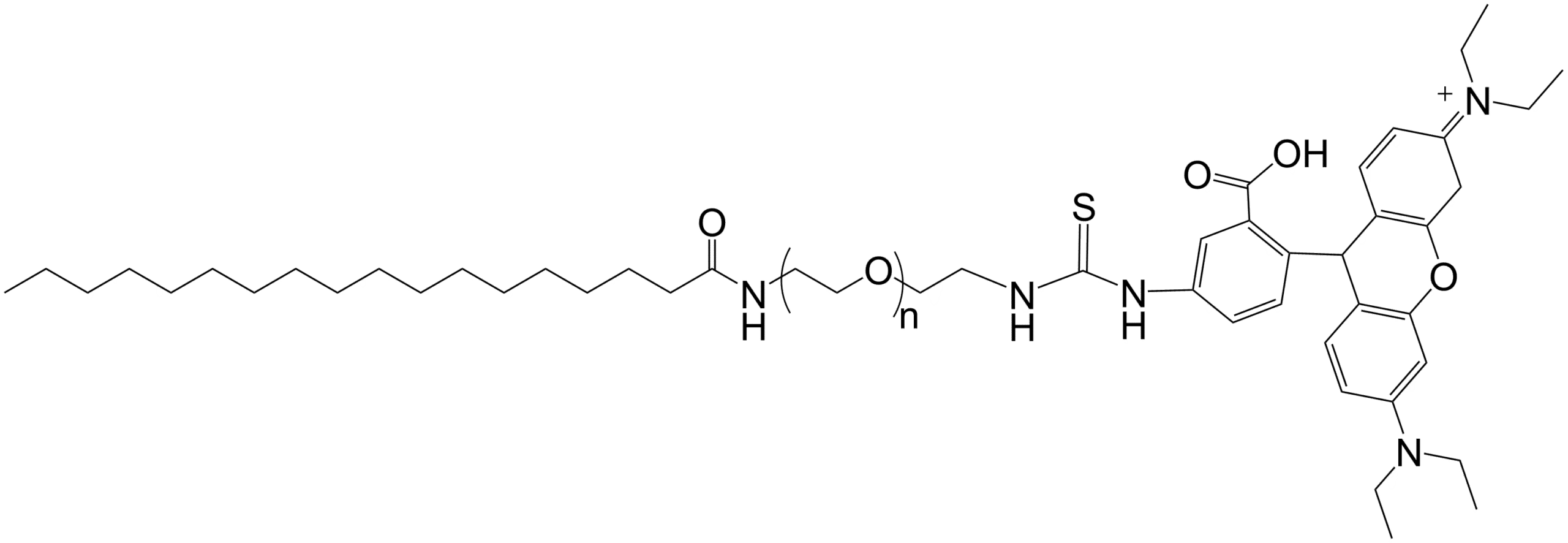
Stearic Acid-PEG-Rhodamine B (SA-PEG-Rhodamine B) is a multifunctional lipid-PEG conjugate composed of stearic acid (C18:0), a polyethylene glycol (PEG) spacer, and a terminal Rhodamine B fluorescent dye. The hydrophobic stearic acid anchor readily inserts into lipid membranes and self-assembled nanostructures, whereas the PEG spacer improves aqueous solubility, steric stabilization, prolonged circulation, and biocompatibility.
Rhodamine B is a highly photostable red fluorescent dye with strong fluorescence intensity and excellent photostability, making this conjugate well suited for fluorescence microscopy, confocal imaging, flow cytometry, nanoparticle tracking, and in vitro and in vivo imaging studies.
Stearic Acid-PEG-Rhodamine B is widely used for fluorescent labeling of liposomes, lipid nanoparticles (LNPs), micelles, extracellular vesicles, drug delivery systems, and other lipid-based nanocarriers.
Applications
- Fluorescent liposome labeling
- Lipid nanoparticle (LNP) tracking
- Polymeric micelle imaging
- Cellular uptake studies
- Fluorescence microscopy
- Confocal microscopy
- Flow cytometry
- Biodistribution studies
- Nanoparticle surface engineering
- Biomaterials research
Features and Benefits
- Hydrophobic stearic acid anchor
- Hydrophilic PEG spacer
- Bright Rhodamine B fluorescence
- Excellent photostability
- Easy incorporation into lipid membranes
- Excellent aqueous dispersibility
- Outstanding biocompatibility
- Research-grade quality